

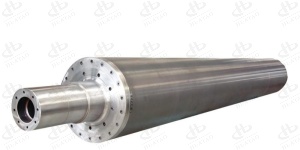
| Product Name | Embossing Calender Roll |
| Material | 38CrMoAlA, 42CrMo, 60CrMo, 9Cr2Mo |
| Surface Hardness | HRC 58–62 |
| Hardened Layer Depth | >5 mm |
| Heating Method | Hollow Inner Tank Spiral Oil Heating / Perimeter Drilled Oil Heating |
| Heating Medium | Thermal Oil |
| Maximum Surface Temperature | 250°C |
| Temperature Uniformity | High Precision Internal Flow Design |
| Surface Finish | Precision Ground & Polished |
Detailed Description of the embossing calender roll
In nonwoven manufacturing, the embossing calender roll serves as the heart of the thermal bonding system. The fiber web is fed between a heated embossing roller and a smooth anvil roll (or a second embossing roll). With temperature and pressure precisely regulated, thermoplastic fibers soften and fuse at designated bonding points, yielding a nonwoven fabric that is strong, stable, and uniform.
Our embossing rollers are built with deep induction quenching technology rather than conventional nitriding. The result is a hardened layer exceeding 5 mm, compared with only 0.4–0.5 mm for traditional nitriding—a substantial gain in wear resistance that keeps embossing geometry precise through years of continuous production.
Thermal oil channel design has been optimized for rapid heat transfer and minimal surface temperature variation, which eliminates uneven bonding, inconsistent embossing depth, and fabric defects caused by hot or cold spots.
Our engineering team customizes embossing patterns to customer specifications—bonding density, pattern depth, spacing, and geometry can all be tailored. The rollers are fully compatible with major European and Asian nonwoven production lines, including equipment from Germany, Taiwan, and China.
Key Features
Deep induction hardened layer exceeding 5 mm for outstanding wear resistance
Premium alloy steel construction for extended service life
Uniform thermal oil heating for consistent surface temperature
Maximum operating temperature up to 250°C
Excellent embossing accuracy and pattern consistency
Custom roller diameter, face length, shaft design, and bearing configuration
Wide selection of embossing patterns and bonding geometries
Compatible with spunbond, meltblown, SMS, SMMS, and bicomponent nonwoven lines
Suitable for high-speed continuous production
Easy maintenance with excellent dimensional stability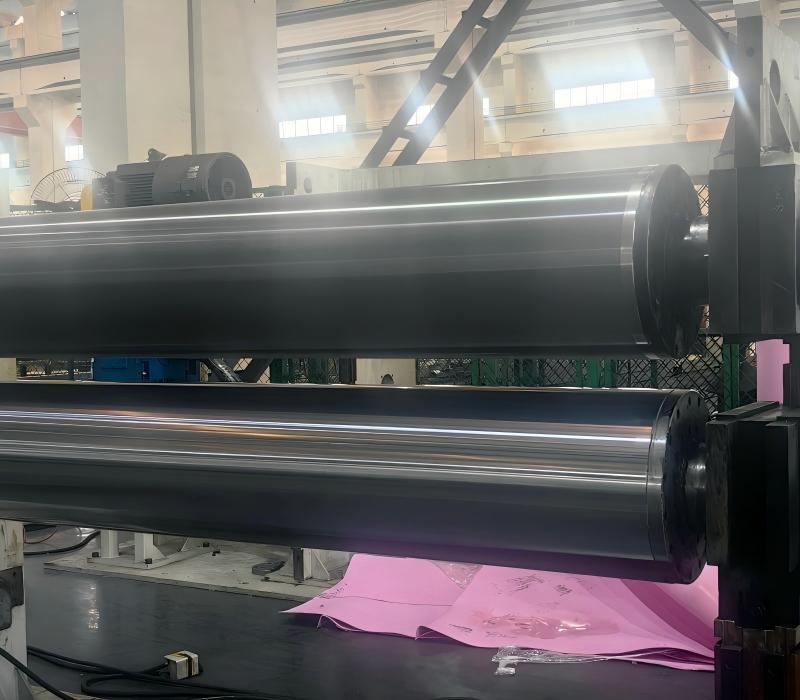
Technical Specifications of the embossing calender roll
| Item | Specification |
|---|---|
| Product Name | Embossing Calender Roll |
| Material | 38CrMoAlA, 42CrMo, 60CrMo, 9Cr2Mo |
| Surface Hardness | HRC 58–62 |
| Hardened Layer Depth | >5 mm |
| Heating Method | Hollow Inner Tank Spiral Oil Heating / Perimeter Drilled Oil Heating |
| Heating Medium | Thermal Oil |
| Maximum Surface Temperature | 250°C |
| Temperature Uniformity | High Precision Internal Flow Design |
| Surface Finish | Precision Ground & Polished |
| Embossing Pattern | Fully Customized |
| Roller Diameter | Customized |
| Face Length | Customized |
| Dynamic Balance | G2.5 or Better |
| Working Speed | Customized According to Production Line |
Available Embossing Patterns of the embossing calender roll
We manufacture embossing calender rolls with customized bonding patterns to suit different fabric properties and applications. Available patterns include:
Square Dot · Round Dot · Oval Dot · Diamond (Rhombus) · Cross · Stripe · Wave · Honeycomb · Mesh · Linen Texture · Leather Texture · Decorative Patterns · Customer-designed Patterns
Pattern depth, pitch, open area, and bonding ratio can all be customized.
Applications
Our heating embossing rollers are widely used in:
Spunbond Nonwoven Production · Meltblown Nonwoven Production · SMS Nonwoven Lines · SMMS Nonwoven Production · Bi-component Nonwoven Fabrics · Medical Nonwoven Fabrics · Hygiene Products · Baby Diapers · Sanitary Napkins · Surgical Gowns · Face Mask Materials · Agricultural Nonwovens · Geotextiles · Filtration Materials · Furniture Fabrics · Automotive Interior Materials
Why Choose Our Heating Embossing Rollers?
Over 20 years of precision roller manufacturing experience
Advanced CNC machining and heat treatment technology
Superior wear resistance compared with conventional nitrided rollers
Stable embossing quality during long-term operation
Fast customization for OEM production lines
Strict dynamic balancing for high-speed applications
Complete engineering support for roller design and optimization
Compatible with international nonwoven production equipment
Frequently Asked Questions
Q1. What is the function of a heating embossing roller?
It thermally bonds thermoplastic fibers by applying controlled heat and pressure, creating strong bonding points and improving the mechanical properties of nonwoven fabrics.
Q2. Why is a deep hardened layer important?
A hardened layer greater than 5 mm provides significantly better wear resistance than traditional nitrided rollers, maintaining embossing accuracy and extending service life.
Q3. What heating method is used?
The roller uses precision-engineered internal thermal oil circulation, available in spiral-flow or perimeter-drilled channel designs, to achieve highly uniform surface temperatures.
Q4. Can the embossing pattern be customized?
Yes. We can manufacture virtually any regular or custom embossing pattern, including dot, diamond, cross, stripe, mesh, and customer-specific designs.
Q5. Which production lines are compatible?
Our rollers are compatible with spunbond, meltblown, SMS, SMMS, and bicomponent nonwoven production lines from major equipment manufacturers in Germany, Taiwan, China, and other regions.
can not be empty
The E-mail format is not correct
can not be empty



HUATAO GROUP - ROLLS
Address: No.298 Zhonghua North Street, Shijiazhuang 050000 China.
Tel: +86 0311 80690567
Email: sale08@huataogroup.com
 WhatsApp & WeChat : +86 13383112591